
Introduction
Mistletoe has a centuries-long cultural history as a holiday decoration and symbol of good luck, which makes it easy to overlook as the plant problem it actually is when it shows up in your trees. Seeing a green ball of growth hanging in a bare winter oak looks almost decorative. In reality it is a parasitic plant that is extracting resources from your tree and, in heavy infestations, can meaningfully stress it.
In Virginia, Eastern mistletoe (Phoradendron leucarpum) is a native species that grows on a range of deciduous hardwoods including oaks, elms, red maples, and sweetgums. It is most visible in winter when host trees have dropped their leaves, though it is present year-round as a dense evergreen ball in the canopy.
This guide covers how mistletoe spreads and establishes in trees, what harm it causes, how to assess whether your tree’s mistletoe is a problem, and what removal actually involves. We see mistletoe regularly on trees we assess across Chesapeake and Hampton Roads, and the questions we get most often are whether it is harmful and whether anything can actually be done about it.
What Is Mistletoe and How Does It Spread?
Eastern mistletoe is a hemiparasitic flowering plant, meaning it photosynthesizes its own carbohydrates through its green foliage but relies on its host tree for water and mineral nutrients. It is not a complete parasite — it makes its own food but steals its water supply.
Mistletoe spreads almost entirely through birds. The plant produces white berries that birds eat, and the seeds pass through the digestive system intact. When birds perch on branches after feeding, seeds are deposited on bark in sticky droppings. Seeds that land in bark crevices or at branch unions can germinate and send root-like structures called haustoria into the host branch’s vascular tissue.
According to the Virginia Department of Forestry, Eastern mistletoe establishes haustoria that grow progressively deeper into the host branch over years, eventually creating a permanent vascular connection that the plant cannot be fully severed from without removing the affected branch. [Source: dof.virginia.gov/forest-management/forest-health/mistletoe] This is why simply pulling off the visible mistletoe growth does not solve the problem — the embedded roots remain and the plant regrows.
How Much Harm Does Mistletoe Actually Cause?
Mistletoe’s impact on a tree depends on the intensity of the infestation and the overall health of the host. Research from the USDA Forest Service indicates that light to moderate mistletoe infestations on otherwise healthy, well-established trees cause relatively minor stress — reduced growth rate, some canopy thinning — that healthy trees manage without serious consequences. [Source: fs.usda.gov/treesearch/pubs/all/forest-disease-notes]
The situation changes significantly when:
The infestation is heavy. Multiple large mistletoe clumps throughout the canopy can extract meaningful amounts of water during drought periods when the host tree is already under stress.
The host tree is already stressed. A tree dealing with drought, root damage, disease, or structural problems has less reserve capacity. Mistletoe parasitism on top of existing stress can accelerate decline. See our blog on signs a tree is structurally unsafe for what to look for.
The mistletoe is on a major scaffold branch. Mistletoe on secondary or tertiary branches in the upper canopy causes less harm than mistletoe established on primary scaffold branches closer to the trunk, where it intercepts a larger share of the host’s water supply.
Young trees are affected. Younger trees with less reserve capacity are more significantly impacted by mistletoe than mature established trees.
In Virginia’s hot, humid summers and periodic drought years, mistletoe’s water extraction from stressed trees is most impactful. Trees in drought years have enough water stress without a parasite adding to it.
Should You Remove Mistletoe From Your Trees?
The decision to remove mistletoe depends on infestation level, tree health, and the location of the mistletoe in the canopy.
One or two small clumps on a healthy mature oak or maple: Low priority. Monitor annually. The tree manages this level of infestation easily.
Multiple large clumps throughout the canopy of a healthy tree: Moderate priority. Pruning out the affected branches during the next scheduled trimming visit is worthwhile to reduce cumulative parasitic load.
Any level of infestation on a tree already showing stress signs: High priority. The additional stress burden is significant on a compromised tree.
Mistletoe on a young or recently planted tree: Remove promptly. Young trees do not have the reserves to manage parasitic load that mature trees handle more easily.
If you are already scheduling a tree trimming or pruning visit, mistletoe removal can typically be incorporated into that visit at minimal additional cost by having the crew prune out affected branches as part of the work.
How to Actually Remove Mistletoe
The Only Effective Method: Remove the Affected Branch
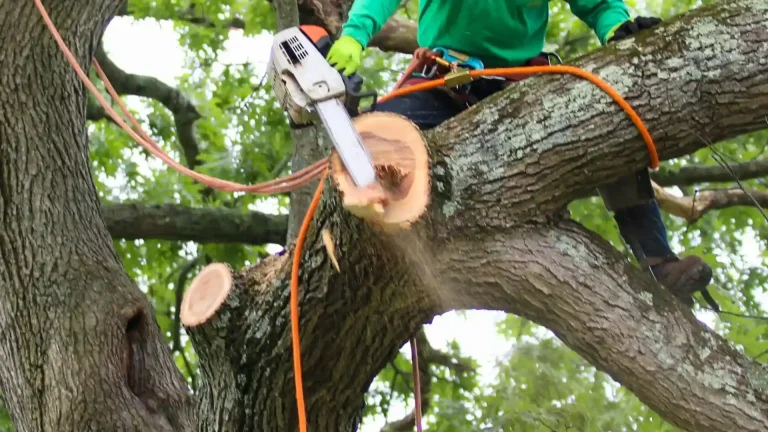
Because mistletoe embeds haustoria into the host branch’s vascular tissue, simply pulling or cutting off the visible mistletoe growth results in regrowth from the remaining embedded roots, usually within one to two growing seasons. The only removal approach that prevents regrowth is pruning the entire branch segment that carries the mistletoe, making the cut at least 12 inches below the lowest visible point of mistletoe attachment. This removes the section of branch where haustoria are embedded along with the visible growth.
When Branch Removal Is Not Possible
When mistletoe is established on a major scaffold branch that cannot be removed without seriously damaging the tree’s structure, suppression is the alternative. Cutting the mistletoe back to the branch surface delays regrowth by a season or two and reduces the parasitic load, though it does not eliminate the plant. This is a maintenance approach rather than a solution, but it is a reasonable strategy for large established infestations on primary branches where removal is not an option.
Ethephon (Chemical Suppression)
Ethephon is a plant growth regulator registered for mistletoe suppression in trees. Applied to mistletoe growth when the host tree is dormant, it causes the mistletoe to drop its leaves and slows regrowth. It does not kill the haustoria embedded in the host and regrowth occurs, but the interval between treatments is longer than mechanical cutting alone. Ethephon application is a licensed pesticide application — not a homeowner DIY treatment. Ask a certified arborist if chemical suppression makes sense for your specific situation.
Mistletoe and Wildlife: The Other Side of the Story
Mistletoe is not purely negative from an ecological standpoint. It provides winter food through its berries for bluebirds, robins, cedar waxwings, and other bird species. Its dense evergreen clumps provide nesting habitat and winter cover. The USDA Forest Service notes that mistletoe plays a meaningful role in forest ecosystems as a food source and habitat element, particularly in winter. [Source: fs.usda.gov] On large rural or naturalized properties, tolerating light mistletoe infestations on healthy trees has genuine ecological benefits. On managed residential landscapes, the calculus is different, particularly for stressed or high-value trees.
Frequently Asked Questions
Is mistletoe killing my oak tree?
A light to moderate mistletoe infestation is unlikely to kill a healthy established oak on its own. However, if your oak is already showing canopy decline, signs of root stress, or other health problems, mistletoe adds stress to an already burdened tree. In that case, removal becomes more urgent. If you are unsure about your tree’s overall health, a professional assessment is worth scheduling.
Can mistletoe spread from my tree to my neighbor’s trees?
Yes, through birds. Removing mistletoe from your trees does not prevent new seeds from being deposited by birds from other infested trees in the area, and your infested trees can be a seed source for neighboring trees. Removal reduces ongoing seed production from your property but does not eliminate reinfection risk.
Can I pick mistletoe from my tree for holiday decoration?
Yes, and doing so is a low-effort way to reduce parasitic load while getting a free seasonal decoration. Just be aware that berries are toxic to humans and pets if ingested. Keep picked mistletoe out of reach of children and animals. The plant regrows from the remaining haustoria, so harvesting does not remove the infestation, but seasonal picking is a benign management habit.
Conclusion
Mistletoe in Virginia trees is caused by birds spreading seeds, and once established, it extracts water from the host through embedded root-like structures that cannot be eliminated by surface removal alone. Light infestations on healthy trees are low priority. Heavy infestations, or any infestation on a stressed tree, warrant pruning out the affected branches.
If you have mistletoe in trees on your Chesapeake, Virginia Beach, or Suffolk property and you want it addressed during a pruning visit, or if you are concerned about the overall health of an affected tree, call 757 Tree Solutions. We will assess the tree and the infestation and give you a clear recommendation on whether and how to address it.