
Introduction
Hampton Roads is full of large trees. Massive loblolly pines that have been growing for fifty years. Water oaks with canopies that span forty feet. Live oaks whose root systems have been in place longer than the neighborhoods around them. These trees are part of what makes Chesapeake, Virginia Beach, and Suffolk beautiful places to live.
They are also among the most difficult and expensive trees to remove when the time comes. A large tree removal is not just a bigger version of a small tree removal. It is a categorically different job that requires more planning, more equipment, more crew, and more time.
This guide explains exactly what makes large tree removal more complicated than smaller jobs. If you have a big tree that needs to come down, this will help you understand what you are actually paying for, what questions to ask your contractor, and what warning signs separate a professional operation from one that is likely to cause problems.
757 Tree Solutions handles large tree removals throughout Chesapeake, Virginia Beach, Suffolk, and Hampton Roads. We want our customers to understand exactly what goes into these jobs.
What Counts as a Large Tree?
In the tree industry, size classifications vary by company, but a common working definition for large trees is anything over sixty feet tall with a trunk diameter exceeding eighteen to twenty-four inches at chest height. Extra-large trees typically start at eighty feet and above, with trunk diameters of thirty inches or more.
In Hampton Roads, the trees that most commonly fall into this category include:
- Mature loblolly pines that have reached full height, often seventy to one hundred feet
- Water oaks and willow oaks in established neighborhoods, frequently sixty to eighty feet
- Large live oaks with wide-spreading canopies and massive trunk diameters
- Tall sweetgums that have been growing for decades in older residential areas
- Mature tulip poplars, which grow fast and can reach significant heights quickly
If you can look at a tree and think it is big, it probably qualifies. But height alone does not tell the full story of what makes a removal complex. The factors below are what actually drive difficulty and cost.
Weight and Physics: The Core Challenge of Large Tree Removal
A large tree contains an enormous amount of mass. A mature loblolly pine can weigh ten thousand to twenty thousand pounds. A large live oak can weigh significantly more. That weight is distributed across a trunk, major scaffold limbs, secondary branches, and thousands of smaller branches and leaves, all arranged in three dimensions above your property.
Removing that mass safely requires controlling where it goes at every step. In a small tree, a section that falls in the wrong direction might knock over a shrub. In a large tree, the same mistake drops hundreds of pounds of wood onto your roof, your fence, or a crew member. The margin for error shrinks as the tree gets bigger.
Weight creates specific technical challenges:
- Individual limb sections on large trees can weigh five hundred to several thousand pounds, which exceeds what hand rigging can safely control
- The trunk base of a large tree, even cut to a short section, may require equipment to move
- Wood debris from a single large tree can fill multiple truck loads, which adds hauling time and cost
- The root system of a large tree extends far beyond the drip line and must be considered when positioning equipment
This is the fundamental reason large tree removal costs more. The physics of controlling that much weight safely require more equipment, more experienced crew, and more time.
Access and Equipment Requirements
Small tree removals can often be handled with a truck, a chipper, and a crew of two or three. Large tree removals frequently require equipment that standard residential tree service companies do not own or operate.
Cranes
As covered in our crane removal blog, many large tree jobs require crane assistance because the sections are too heavy to rig and lower manually, or because there is no safe drop zone for sectioned wood. A crane on a large tree job is not unusual. It is often the standard approach. The crane itself is a significant equipment cost on top of the crew cost, which contributes to large tree pricing being substantially higher than small tree pricing.
Aerial Lifts and Specialized Climbing Equipment
Reaching the top of an eighty-foot pine or the outer canopy of a large live oak requires climbing gear and technique that goes well beyond basic tree work. Arborists working at height on a large tree are exposed to greater risk with every cut, and the rigging systems used to control sections must be sized appropriately for the weight involved. The crew doing this work needs to be genuinely experienced, not just confident.
Access Routes for Equipment
Getting a crane or a large chipper truck into position often requires navigating residential lots, narrow gates, soft lawns, and tight driveways. An on-site estimate is essential for large tree jobs because equipment access is something you cannot assess from a photo or a description. A job that looks straightforward from the street can have significant access complications that affect both the approach and the cost.
Debris Handling Equipment
A large tree generates an extraordinary volume of debris. Large chippers, log trucks, and multiple haul trips are often required. Debris management on a large job can take as long as the actual removal. Budget and timeline for large tree jobs should account for the full cleanup, not just the cutting.
Proximity to Structures and the Complexity It Creates
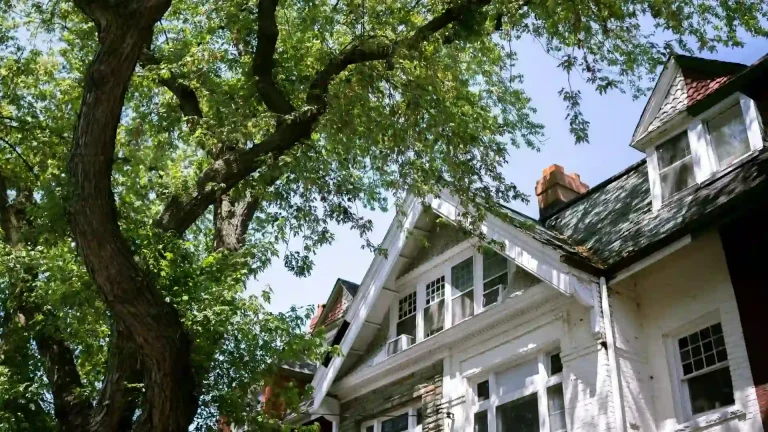
A large tree in the middle of an open field is a big job but a manageable one. A large tree twenty feet from a house with a fence on one side, a pool on the other, and a power line overhead is a completely different problem.
In established Chesapeake and Virginia Beach neighborhoods, large trees are rarely in open, unobstructed locations. They grew up alongside homes, garages, sheds, driveways, and fences that were built before the tree reached its current size. What was once a manageable young tree is now a mature specimen hemmed in on all sides.
Proximity complications on large tree jobs include:
- No clear drop zone for any section of the tree, requiring every piece to be rigged or craned out
- Work zone establishment that requires cordoning off neighboring property or the street
- Risk of damage to surrounding landscaping, hardscaping, or structures from equipment positioning
- Coordination with utility companies if the canopy or removal path intersects power lines
- Structural assessment of what the tree is leaning against or touching before any cuts are made
Every constraint on a large tree job adds time and complexity. A job that would take four hours in an open yard can take a full day or more in a tight residential setting. That time difference is reflected in the price.
Why Large Tree Jobs Require More Extensive Planning
Experienced tree crews do not show up to a large tree job and start cutting. They plan. A professional large tree removal starts with a thorough on-site assessment that considers every factor before a single piece of equipment is deployed.
What a proper large tree assessment covers:
- Tree height and canopy spread measurement to determine equipment reach requirements
- Trunk diameter and lean assessment to identify the natural fall direction and any structural bias
- Root zone evaluation to understand what the root system is doing and where major roots are located
- Identification of all structures, utilities, and obstacles within the fall zone and equipment staging area
- Removal sequence planning: which limbs come off first, where crane attachment points will be, how sections will be staged for chipping or hauling
- Crew role assignment so everyone on the job knows exactly what they are doing and when
This planning phase is invisible to the homeowner but is what separates a professional large tree removal from a dangerous one. If you hire a crew that shows up and goes straight to work on a large tree without walking the job first, that is a red flag worth paying attention to.
What to Look for When Hiring for Large Tree Removal
Large tree removal is where the difference between a qualified crew and an unqualified one matters most. The stakes are higher, the equipment requirements are greater, and the consequences of mistakes are more severe.
On-site estimate only. Any company willing to quote a large tree removal by phone or photo is either guessing or not planning to do it properly. Large jobs require in-person assessment. No exceptions.
Crane capability. Ask directly whether they have access to crane equipment and have experience using it on residential properties. Large tree jobs near structures almost always benefit from crane involvement.
Proper insurance. Liability coverage for large tree jobs should be substantial. Ask for the certificate of insurance and verify that the coverage limits are appropriate for the scope of work near your home.
Crew experience with large trees specifically. Removing a large tree is a different skill set from trimming or removing small trees. Ask how often they handle large removals and whether they can walk you through their approach for your specific tree.
Clear communication about the plan. A professional crew will be able to explain their removal sequence, where equipment will be positioned, and what areas of your property need to be cleared before the job begins.
Frequently Asked Questions
How much does large tree removal cost in Chesapeake VA?
Large tree removal in Chesapeake typically starts around $1,200 to $1,800 for a sixty to eighty foot tree in a reasonably accessible location. Extra-large trees over eighty feet, trees requiring crane work, or trees in tight locations near structures can run $2,500 or significantly more. Stump grinding is usually quoted separately. An in-person estimate is the only reliable way to price a specific job.
How long does large tree removal take?
A large tree in an accessible location with a competent crew typically takes four to eight hours. A large tree near structures requiring crane work in a tight residential lot can take a full day or more. Debris hauling and cleanup add time to any job. Multi-day jobs are not unusual for very large or complicated removals.
Can any tree company remove a large tree?
Technically yes, but not all companies should. Large tree removal requires equipment, experience, and planning that not all tree services have. A company comfortable with residential trimming and small removals may not have the crane access, the rigging experience, or the crew size to handle a large complicated removal safely. Verify capability before hiring.
Is it possible to remove a large tree without a crane?
Yes, in the right conditions. A large tree in an open area with adequate drop zones can be sectioned down without crane assistance using climbing and rigging. When the tree is near structures or in a confined space, crane removal becomes necessary. The decision should be made based on what is safe for that specific job, not on cost alone.
Do I need a permit to remove a large tree in Chesapeake VA?
Chesapeake and some neighboring municipalities have tree ordinances that may require permits for removing trees above a certain size on residential or commercial property. Requirements vary by jurisdiction and property type. 757 Tree Solutions researches permit requirements as part of the estimate process and will let you know if a permit is needed for your job.
Conclusion
Large tree removal is one of the most demanding jobs in the tree care industry. The weight, the height, the equipment requirements, the proximity to structures, and the planning required all contribute to why these jobs cost more and take longer than smaller removals.
When you understand what goes into a large tree removal, the price makes sense. You are paying for experienced crew, specialized equipment, careful planning, and the liability coverage that protects your property if something goes wrong. Choosing the lowest quote on a large tree job without verifying those factors is one of the riskier decisions a homeowner can make.
757 Tree Solutions handles large and extra-large tree removals throughout Chesapeake, Virginia Beach, Suffolk, and Hampton Roads. We provide free on-site estimates, bring crane capability when jobs require it, and will walk you through our removal plan before we start. Call us to schedule your assessment.