
Introduction
One of the first questions homeowners ask when scheduling tree removal is how long it will take. It is a reasonable question. You need to know whether to take a half day off work, whether your driveway will be blocked, whether you need to arrange somewhere for the kids to be.
The honest answer is that tree removal timelines vary significantly depending on factors that are specific to each job. A one-size-fits-all answer is not useful. What is useful is understanding which factors drive the timeline so you can have a real conversation with your contractor and plan your day accurately.
This guide covers tree removal timelines for different tree sizes, the difference between traditional and crane removal, how emergency jobs affect scheduling, and what commonly delays a removal that looked straightforward at the estimate stage. We handle removal jobs across Chesapeake, Virginia Beach, Suffolk, and Hampton Roads every week, and these are the realistic numbers based on actual job experience.
By the end of this you will know exactly what to expect on your removal day.
Tree Removal Timeline by Tree Size
Size is the most reliable predictor of how long a removal will take, assuming access is straightforward and no unusual complications are present. Here is a realistic breakdown by tree size category.
| Tree Size | Typical Duration | What Drives This Estimate |
| Small (under 30 ft) | 1–2 hours | Limited debris, manageable sections, often no rigging needed |
| Medium (30–60 ft) | 2–4 hours | Multiple sections, more debris volume, basic rigging typically required |
| Large (60–80 ft) | 4–8 hours | Heavy sections, significant debris, often requires crane or extensive rigging |
| Extra Large (80+ ft) | Full day or more | Maximum debris volume, crane typically required, complex sectioning |
These ranges assume a crew of three to four people in a location with reasonable access. Add time for confined spaces, proximity to structures, or difficult access routes.
What the Timeline Actually Includes
When we give a time estimate, we are accounting for the full job from crew arrival to site cleanup. Homeowners sometimes expect the tree to be gone in the time it takes to cut it down, but that is only one part of the process. Here is what the clock is actually running on.
Setup and Assessment (15 to 30 Minutes)
Every professional crew walks the job before starting. Equipment gets positioned, work zones get established, roles get assigned, and the removal sequence gets confirmed. On larger jobs with crane involvement this setup phase takes longer. Skipping it is a red flag. On a well-run job you will see a few minutes of activity before anyone touches the tree.
Active Removal (Varies by Tree)
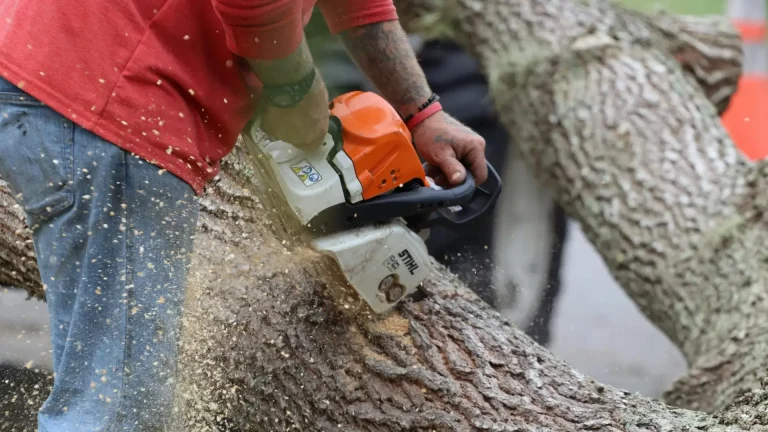
This is the cutting phase, from the first limb coming off to the final trunk section hitting the ground. On a small tree this can be thirty to forty-five minutes. On a large tree near a structure with a crane, the controlled sectioning alone can take three to four hours. The more precision required, the slower the pace, which is exactly right.
Debris Processing (Often Equals or Exceeds Removal Time)
Branches and wood sections have to be chipped, stacked, or hauled. A medium-sized tree generates a surprising volume of debris. Running material through a chipper, loading logs, and hauling full chip loads off-site can take as long as the removal itself on larger jobs. This is often the part of the estimate that surprises homeowners when they watch the clock.
Final Cleanup and Site Restoration
Blowing debris off the driveway, raking the lawn area, removing equipment, and doing a final walkthrough to confirm the site is clean. On a well-run job the property should look better when the crew leaves than it did when they arrived, minus one tree. This phase typically runs fifteen to thirty minutes on most residential jobs.
Crane Tree Removal vs Traditional Removal: How Timelines Differ
Homeowners sometimes assume crane removal takes longer because it involves more equipment. That is not always true. For large trees or confined spaces, crane removal can actually be faster than traditional sectioning because the crane handles the heavy lifting that would otherwise require multiple rigging setups per section.
Traditional Removal Timeline Factors
- Climber ascent and rigging setup for each section adds time per cut
- Sections must be lowered manually, which requires ground crew coordination on every piece
- Without a crane, the removal sequence is constrained by what can be safely rigged from below
- Large sections that require extensive rigging can slow the job significantly
Crane Removal Timeline Factors
- Crane setup and positioning takes fifteen to thirty minutes at the start of the job
- Once the crane is in position, sections can be lifted and swung to the drop zone quickly
- The crane removes the need for extensive rigging on each individual section
- For large trees over structures, crane removal is often the fastest safe option
- Crane jobs require a larger crew, which also speeds up debris processing
For a large tree over a roofline in Chesapeake, a crane removal might take five to six hours total including setup and cleanup. The same tree removed traditionally in a confined space could take eight hours or more with far more risk. The crane earns its cost in both time and safety on the right jobs.
Emergency Tree Removal vs Scheduled Removal: Timeline Differences
Emergency removal after a storm introduces two separate timeline questions: how long until the crew arrives, and how long the actual job takes once they are there.
Response Time on Emergency Calls
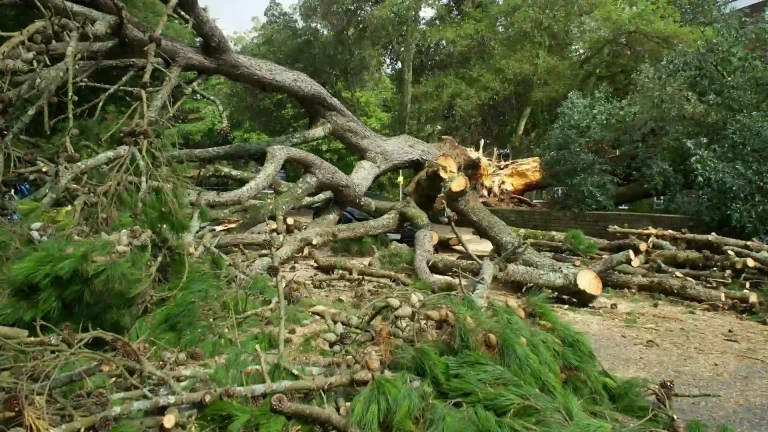
A local tree service responding to an emergency with a tree on a structure can often arrive within one to four hours during normal conditions. After a major storm event affecting Hampton Roads broadly, response times stretch because multiple emergency calls are coming in simultaneously. Active structure threats get prioritized. Yard cleanup waits.
757 Tree Solutions prioritizes emergency calls where a tree is on an occupied structure or actively blocking emergency access. If your situation is urgent, communicate that clearly when you call and describe exactly what the tree is in contact with.
Job Duration on Emergency Removals
Once on-site, an emergency removal takes the same amount of time as a scheduled removal of comparable size and complexity, sometimes longer. A tree on a structure is under tension and compression in unpredictable ways that require more careful execution. Emergency jobs do not get rushed. Rushing a removal on a compromised structure is how additional damage happens.
Scheduled Removal Lead Times
For non-emergency scheduled removals in Chesapeake VA, booking lead times typically run one to two weeks during normal periods and three to four weeks during peak seasons. Spring and fall are the busiest periods for scheduled removals. If you have a tree that needs to come down but is not an active hazard, scheduling sooner rather than later gives you more flexibility on timing.
What Delays Tree Removal Projects
Even well-planned removals sometimes run longer than estimated. Here are the most common causes of delays and how to minimize them.
Weather
Tree crews cannot safely work in lightning, high winds, or heavy rain. If weather deteriorates during a job, work stops until conditions clear. If a scheduled job day brings severe weather, it gets rescheduled. In Hampton Roads where afternoon thunderstorms are common in summer, morning start times reduce weather-related interruptions significantly.
Access Problems Discovered On-Site
A gate that is narrower than it appeared in photos. A soft lawn that cannot support equipment after recent rain. A neighbor’s fence that was not visible from the street and now complicates the drop zone. These are real situations that add time or require equipment repositioning. The best way to prevent them is an in-person estimate where the crew lead walks the full access route before the job day.
Unexpected Tree Condition
A tree that looked structurally sound during the estimate may reveal hidden decay once the crew is in it. Internal rot that was not visible from the ground changes how the tree can be safely sectioned. This slows things down because the removal sequence has to adapt to what is actually there, not what was assumed.
Permit Requirements
Some tree removals in Chesapeake VA require permits depending on tree size, species, and location. If a permit is needed and was not obtained before the job day, work cannot legally begin. 757 Tree Solutions researches permit requirements as part of the estimate process to prevent this from becoming a surprise on job day.
Utility Coordination
Jobs that require Dominion Energy to de-energize a nearby power line depend on the utility’s schedule, not the tree crew’s. If that coordination was not completed before the job day, the removal cannot proceed until it is. For any job involving lines, utility coordination should be locked in well before the scheduled removal date.
How to Prepare Your Property to Keep the Job on Schedule
- Clear vehicles from the driveway and any area within the tree’s fall zone before the crew arrives
- Unlock any gates the crew will need to access with equipment
- Move any portable items such as patio furniture, potted plants, or grills away from the work area
- Keep children and pets inside or away from the property during the removal
- If there are irrigation lines, invisible fence wires, or other underground utilities in the work area, mark them or let the crew know before they start
- Make sure you or a responsible adult is available on-site or reachable by phone throughout the job
A property that is prepped and ready when the crew arrives is a job that starts on time and finishes on schedule.
Frequently Asked Questions
Can tree removal be done in one day?
Most residential tree removals are completed in a single day. Very large trees, multi-tree jobs, or removals involving complex crane work on confined lots can extend into a second day. When booking your job, ask the crew directly whether they expect to finish in one visit or whether a follow-up may be needed.
Does stump grinding add time to the removal day?
Yes, typically thirty minutes to an hour per stump depending on diameter. If you are adding stump grinding to the removal, factor that into your day. It is almost always worth doing same-day since the equipment and crew are already on-site, but it does extend the total job time.
How long does it take to get a tree removal scheduled in Chesapeake VA?
For non-emergency removals, lead times at 757 Tree Solutions typically run one to two weeks. During peak periods in spring and after major storm events, wait times can extend to three to four weeks for scheduled work. Emergency situations are handled as quickly as crew availability allows, usually same-day for active structure threats.
What time of day does tree removal typically start?
Most crews start between seven and eight in the morning. Early starts take advantage of cooler temperatures, reduce the risk of afternoon storm interruptions common in Hampton Roads summers, and give the crew maximum daylight for larger jobs. If your job has a specific start time requirement, communicate that when booking.
Do I need to be home during the tree removal?
You do not need to be physically present for the entire job, but someone reachable by phone should be available in case questions arise. Being home at the start of the job to walk through any last details with the crew lead is a good practice. If you cannot be there, make sure access arrangements are confirmed and the crew has a direct contact number.
Conclusion
Tree removal timelines in Chesapeake VA range from under two hours for a small tree in an open yard to a full day or more for a large tree in a confined space near structures. The size of the tree is the starting point, but access, method, debris volume, and site conditions all shape the actual time on the ground.
The best way to get an accurate timeline for your specific job is an in-person estimate. A crew that can walk your property, assess the tree, and identify any complications will give you a far more reliable estimate than any general range can.
757 Tree Solutions provides free on-site estimates across Chesapeake, Virginia Beach, Suffolk, and Hampton Roads. Call us to schedule yours and we will give you a clear timeline and a straight price before any work begins.